China’s Rotary Uv Printer market will remain highly competitive in 2026. This guide introduces ten notable Chinese suppliers for cylindrical and curved-surface printing applications. Their machines may support bottles, tumblers, tubes, jars, and other round products. Buyers can compare print diameter, loading methods, ink performance, curing systems, and production speed.
The selection focuses on practical evidence rather than attractive claims. It considers factory experience, technical documentation, product consistency, export support, warranty terms, and available spare parts. Demonstrations, sample prints, and customer references also matter. A sharp logo on a white tumbler is useful evidence, but it does not prove long-term reliability. Ask for repeated samples, not one perfect piece.
Supplier rankings can change quickly. New models appear, and after-sales performance is difficult to measure from public information alone. This guide may not identify the ideal partner for every business. That limitation deserves attention. A small workshop may value simple operation and local support, while a packaging factory may need automation and stable daily output. Buyers should confirm material compatibility, ink adhesion, curing results, training, and service response before placing an order. Factory visits or live video inspections can reveal details that brochures often hide. Check the printhead condition, machine alignment, cable routing, and working environment. Small details matter.
Use this overview as a research starting point. Compare verified specifications with your actual production needs. Reliable decisions require more than a low quotation.
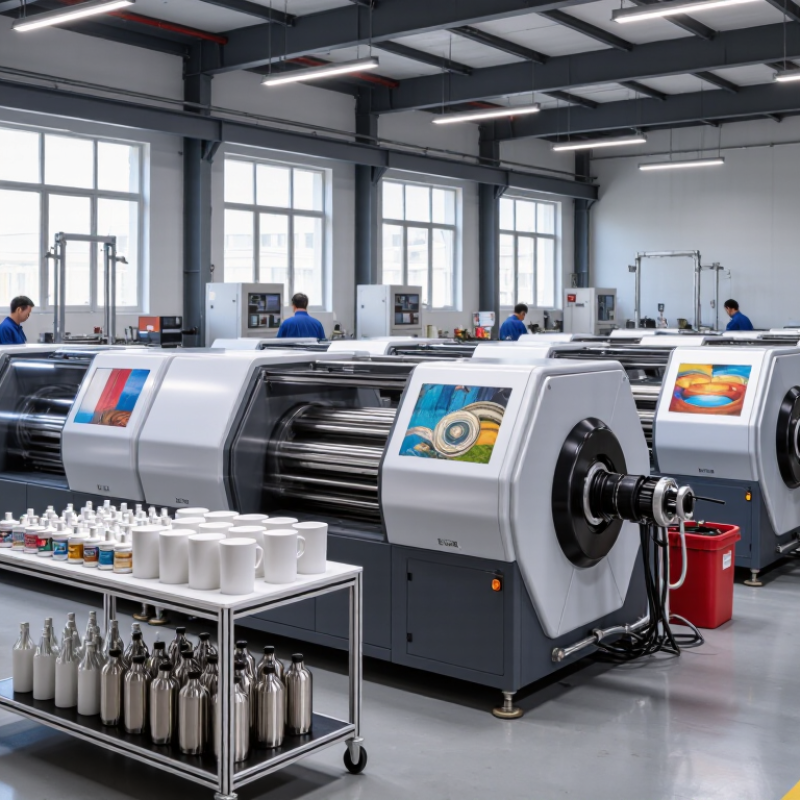
A rotary UV printer applies ultraviolet-curable ink to cylindrical or tapered objects. Unlike a flatbed printer, it rotates the workpiece while the print head moves across its surface. Bottles, tubes, cups, and metal cylinders can pass through this process. The rotating fixture keeps the image aligned with the object’s curve.
Not just a spinning jig.
The operator secures the item and enters its diameter, length, and print position. Sensors help control rotation speed and carriage movement. As the object turns, tiny ink droplets form text, graphics, or detailed patterns.
UV LED lamps cure each layer almost immediately. This reduces smearing during handling. White ink can create a stronger base on dark surfaces. Clear ink may add texture or a raised visual effect.
Some machines print several colors in one controlled pass.
Practical results depend on calibration, surface preparation, and fixture quality. Dust, fingerprints, or uneven coatings can cause weak adhesion. A glossy bottle may look perfect at the center but distort near its shoulder.
That detail is easy to miss. Technicians should test rotation accuracy, ink curing, and image scale before production. A small sample can reveal banding, color shifts, or stretching.
The process is repeatable, but never automatic. Operators still need judgment when objects taper, flex, or vary slightly in size. Careful maintenance also protects print quality, including nozzle checks, lamp inspection, and regular cleaning.
China’s rotary UV printer market is changing quickly in 2026. Buyers no longer judge suppliers by machine speed alone. Demand is shifting. They want stable cylindrical printing, cleaner curing, and shorter setup times. A typical workshop may print bottles, tubes, metal cups, or small packaging batches. These jobs need accurate rotation, steady ink flow, and software operators can learn quickly. Supplier rankings now reflect the whole production experience, not just catalog specifications.
The strongest Chinese suppliers are investing in servo-driven rotary units, automatic diameter adjustment, and improved UV curing control. These upgrades reduce banding on curved surfaces and maintain color density across production runs. Some manufacturers also offer remote diagnostics, sample testing, and operator training before shipment. This shows practical expertise. Buyers should request test prints on their actual materials, including coated metal, glass, acrylic, and flexible plastics. A polished demonstration helps, but repeatability matters more.
Price remains influential, yet low entry costs can hide maintenance delays, consumable restrictions, or limited technical support. The picture is not perfect. Some suppliers still overstate throughput under ideal conditions. Ask for measured output, curing data, warranty terms, and local response times. Not always easy. Independent inspection and a written acceptance checklist can reduce avoidable disputes. In 2026, the top ten suppliers will likely be separated by reliability, customization, and service discipline rather than headline speed.
Evaluating China’s top rotary UV printer suppliers in 2026 requires more than comparing website prices. In practical testing, inspect how each machine handles bottles, tumblers, and tapered containers. Ask suppliers to print your actual materials, not only polished showroom samples. Check rotary diameter range, chuck stability, print resolution, curing consistency, and ink adhesion after rubbing. A clean test print is useful. It is not proof of durability.
Technical evidence should accompany every claim. Request nozzle specifications, RIP compatibility, maintenance procedures, and measured production speed. Confirm whether speed changes with white ink, varnish, or complex artwork. Review factory quality records, operator training, and electrical safety documentation. Supplier experience matters when unusual shapes create banding or registration errors. Ask for dated customer references and machine videos made during continuous production, rather than edited demonstrations.
Reliable support often separates a workable purchase from an expensive delay. Evaluate response times, remote diagnostics, spare-parts availability, installation training, and warranty terms in writing. Clarify who pays for travel and replacement components. A factory audit can reveal packing standards, test procedures, and unfinished assembly. Do not choose the lowest quotation automatically. Field testing can reveal difficult maintenance hidden by attractive samples. No supplier is perfect; compare documented weaknesses honestly before ranking the final ten.
China’s Top 10 Rotary UV Printer Suppliers in 2026 reflect a market shaped by customization, short production runs, and faster delivery. Grand View Research valued the global digital printing market at over US$35 billion in 2022, with steady growth expected through 2030. This expansion supports demand for rotary systems that print directly onto bottles, tubes, cylinders, and other curved surfaces.
The strongest Chinese suppliers usually offer adjustable chucks, rotary attachments, UV LED curing, and white-ink circulation. These details matter on a real production floor. A loose fixture can create banding within minutes. Uneven curing can leave glossy and dull areas on the same container. Suppliers with ISO-based quality procedures, documented nozzle testing, and responsive technical service deserve closer attention. Smithers’ digital print research also highlights automation, variable data, and shorter setup times as important industry trends.
Price alone is a weak filter. Some suppliers advertise impressive speed, yet their effective output falls after cleaning, calibration, and material changes. The top ten should therefore be compared through verified sample tests, ink adhesion checks, warranty terms, and spare-parts availability. The ranking is not flawless. Customer feedback can be uneven, and published specifications may not match workshop results. Buyers should request a printed sample using their actual substrate before signing a purchase agreement. Small details often decide long-term value.
Industry benchmark dimensions used to evaluate rotary UV printer suppliers, based on practical purchasing factors such as print quality, production capability, application flexibility, automation, and after-sales support. Scores are normalized on a 100-point scale and do not represent individual company or brand data.
Higher scores indicate stronger importance or performance in the 2026 supplier evaluation framework. Print quality and production reliability receive the greatest weighting because they directly affect output consistency and operating costs.
China Top 10 Rotary UV Printer Suppliers in 2026
Choosing among China’s leading rotary UV printer suppliers requires more than reading a ranking. Compare technical fit, production evidence, and long-term support. Ask each supplier for a live demonstration on your actual bottle, tumbler, or cylindrical sample. Check print resolution, curing performance, rotation accuracy, ink adhesion, and drying time. A showroom sample can look perfect. Your material may behave differently.
Request a complete specification sheet, including maximum diameter, print speed, software compatibility, power requirements, and acceptable ink types. Examine the machine frame, rotary fixture, UV lamp, and emergency controls during a video inspection. Reliable suppliers should provide installation guidance, operator training, spare-parts lists, and a clearly written warranty. Their answers should remain consistent across sales, engineering, and service teams.
Do not compare only the quoted machine price. Calculate shipping, installation, consumables, maintenance, and possible downtime. Ask for export references and recent customer feedback, while protecting confidential business information. Certifications can support credibility, but they do not replace testing. I would also request a small paid sample run before ordering. It costs more.
That extra step exposes uneven colors, awkward fixtures, or slow communication. Some suppliers respond quickly before payment, then become less available later. This is easy to overlook. Keep written records of promised delivery dates, software updates, training hours, and replacement-part availability. A supplier with transparent limitations may be safer than one making perfect claims.
The table below is an anonymous supplier-screening framework. Figures are practical benchmark ranges for Chinese rotary UV printer sourcing and should be confirmed through technical datasheets, sample testing, factory audits, and signed quotations before purchase.
| Rank | Anonymous Supplier Profile | Typical Rotary Application | Recommended Print Diameter | Typical Print Width | UV Ink Configuration | Indicative Production Speed | Supported Materials | Control & Workflow | Quality Evidence to Request | Indicative Lead Time | Best-Fit Buyer | Due-Diligence Rating |
|---|---|---|---|---|---|---|---|---|---|---|---|---|
| 1 | Supplier Profile A High-volume industrial integrator |
Full-wrap printing on bottles, tumblers, tubes, and cylindrical containers | 25–180 mm | Up to 300–400 mm | CMYK, optional white and varnish; confirm ink adhesion by substrate | Approximately 20–45 pieces/minute, depending on artwork and diameter | Coated metal, glass, ceramic, treated plastic, and selected wood products | Windows RIP workflow, rotary encoder, adjustable chuck or roller fixture | Factory acceptance test, repeatability report, ink SDS, and sample-production video | 25–45 working days | Established packaging and promotional-product manufacturers | ★★★★★ |
| 2 | Supplier Profile B Mid-range customization specialist |
Short-run personalized drinkware and promotional products | 20–120 mm | Up to 250–350 mm | CMYK + white; varnish usually optional | Approximately 12–30 pieces/minute | Glass, stainless steel, acrylic, ABS, PVC, and coated aluminum | Rotary attachment with adjustable speed and RIP color-management tools | Before-and-after adhesion testing, nozzle-check records, and calibration procedure | 20–40 working days | Customization shops and regional print-service providers | ★★★★☆ |
| 3 | Supplier Profile C Compact workshop solution provider |
Small cylindrical items, sample orders, and craft production | 15–90 mm | Up to 200–300 mm | CMYK; white ink availability must be confirmed | Approximately 6–18 pieces/minute | Coated metal, glass, ceramic, wood, and rigid plastics | Desktop or floor-standing configuration; manual loading is common | Printhead maintenance plan, spare-parts list, and operator training scope | 15–35 working days | Start-ups, studios, and low-to-medium-volume buyers | ★★★★☆ |
| 4 | Supplier Profile D Packaging-line automation supplier |
Integrated printing for containers moving through a production line | 30–160 mm | Up to 300–500 mm | CMYK + white; pretreatment and varnish options depend on the line design | Approximately 25–60 pieces/minute | Glass, metal, PET, HDPE, and other tested packaging substrates | PLC integration, automatic feeding, sensor control, and rotary registration | Line-integration drawing, cycle-time test, electrical schematic, and FAT documentation | 35–70 working days | Packaging converters and contract manufacturers | ★★★★★ |
| 5 | Supplier Profile E Large-format UV equipment supplier |
Large tumblers, industrial tubes, signs, and oversized cylindrical objects | 50–300 mm | Up to 500–1,000 mm | CMYK + white; varnish and light colors may be optional | Approximately 4–15 pieces/minute | Wood, acrylic, glass, metal, ceramic, and rigid board with suitable pretreatment | Large-format RIP, multi-fixture rotary bed, and adjustable vacuum or mechanical support | Maximum-load test, dimensional tolerance report, and long-run nozzle stability test | 30–60 working days | Sign manufacturers and large-format specialty printers | ★★★★☆ |
| 6 | Supplier Profile F Export-oriented OEM/ODM supplier |
Private-label machines for distributors and overseas resellers | 20–180 mm | Up to 300–600 mm | CMYK + white; final configuration is quotation-dependent | Approximately 10–35 pieces/minute | Common coated and rigid substrates after application testing | Custom language interface, remote diagnostics, and distributor branding options | Business license, export references, spare-parts policy, and warranty exclusions | 30–60 working days | Distributors requiring customization and territory support | ★★★★☆ |
| 7 | Supplier Profile G Direct-to-object application specialist |
Personalized cylindrical gifts, cosmetics packaging, and decorative objects | 20–130 mm | Up to 250–400 mm | CMYK + white; varnish and primer options require substrate validation | Approximately 8–25 pieces/minute | Glass, ceramic, coated metal, plastic, and selected leather-like materials | Rotary jig library, adjustable print height, and artwork nesting support | Sample approval, color-profile test, maintenance video, and replacement-part pricing | 20–45 working days | Giftware, cosmetics, and decorative-product producers | ★★★★☆ |
| 8 | Supplier Profile H Budget-focused entry-level supplier |
Basic customization and low-volume cylindrical printing | 15–100 mm | Up to 200–300 mm | Usually CMYK; white ink and circulation systems should be verified | Approximately 4–15 pieces/minute | Coated or pretreated glass, metal, ceramic, and plastic | Manual loading, basic RIP, and limited automation | Printhead model, ink cost per item, warranty terms, and service-response commitment | 15–35 working days | New entrants with limited volume and lower capital budgets | ★★★☆☆ |
| 9 | Supplier Profile I Specialty precision-printing supplier |
Small-diameter tubes, laboratory containers, and detailed graphics | 8–70 mm | Up to 200–350 mm | CMYK + white; fine-detail performance depends on printhead and curing setup | Approximately 5–20 pieces/minute | Glass tubes, coated aluminum, engineering plastics, and ceramics | Precision rotary positioning, fine-step adjustment, and controlled UV curing | Resolution test, concentricity tolerance, curing-energy record, and microscopic print inspection | 25–50 working days | Technical, laboratory, and premium small-format product manufacturers | ★★★★☆ |
| 10 | Supplier Profile J Service-led regional supplier |
General-purpose UV printing with local installation and training support | 20–150 mm | Up to 250–450 mm | CMYK + white; optional channels vary by machine configuration | Approximately 8–28 pieces/minute | Common rigid materials after cleaning, coating, or primer preparation | Standard RIP, remote support, on-site commissioning, and operator training | Service-level agreement, technician availability, customer references, and spare-stock location | 20–45 working days | Buyers prioritizing installation, training, and after-sales support | ★★★★☆ |
| Selection reminder: Compare total cost of ownership rather than machine price alone. Confirm printhead availability, ink compatibility, curing performance, rotary-jig accuracy, electrical standards, warranty coverage, spare-parts lead time, installation scope, and tested samples on your actual products. | ||||||||||||